New faces are not enough: what kind of leadership Ukrainians expect
Nearly seven in ten respondents in late 2025 said Ukraine needed new political leaders. Yet in a 2026 study, honesty was the quality people most often wanted in a candidate, followed by political experience. The pull between renewal and experience is a tension that anyone seeking power in the future will have to resolve.


We compared studies by the Razumkov Centre, NDI and KIIS, along with a supplementary online survey by Active Group. In Razumkov's data, the share of people who would vote for experienced politicians rose from 16% to 21.7% in a year, even though most still prefer new faces.
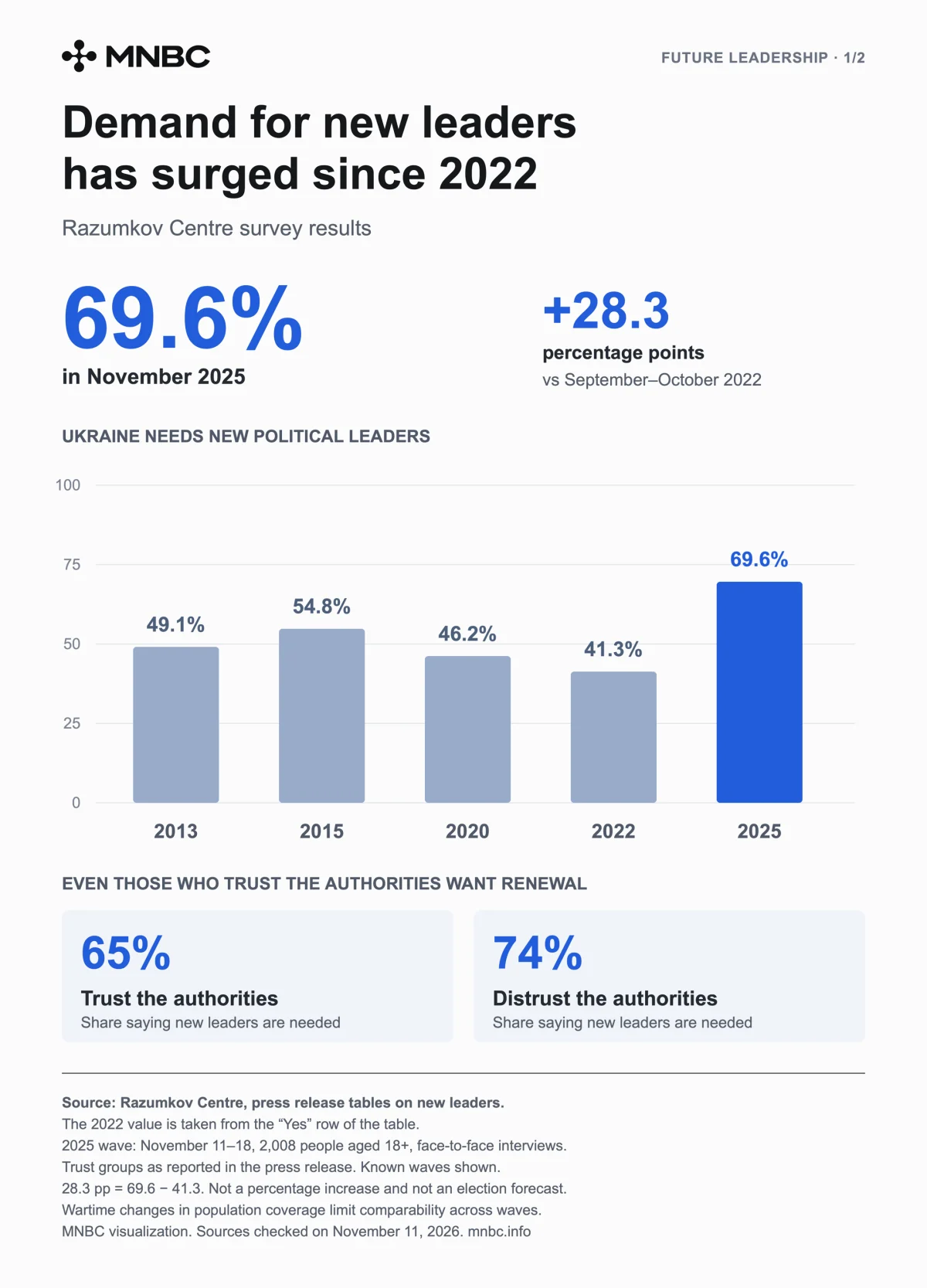
Even those who trust the authorities want renewal
According to the Razumkov Centre, 41.3% of respondents said in September–October 2022 that Ukraine needed new political leaders. By November 2025, that figure had reached 69.6%. By our calculation, that is an increase of 28.3 percentage points.
A majority voiced this need regardless of how they felt about the authorities. New leaders were wanted by 65% of those who trusted the authorities and by 74% of those who did not.
People can trust those in power today and still expect new leaders to emerge. Demand of this kind leaves room for refreshing teams and bringing in different experience.
65% of those who trust the authorities also want new political leaders.
Most would still choose new faces
The same Razumkov survey offered a direct choice between people who have never held power and experienced politicians who have already held office. New faces still come out ahead, but over the past year the share favoring experienced politicians has grown.
Who respondents would be more likely to vote for in the next election, November 2024 → November 2025
- New faces, people who have never held power: 57.5% → 56.2%
- Experienced politicians who have already held power: 16.0% → 21.7%
- Hard to say: 26.4% → 22.1%
The share of those who would choose experienced politicians rose by 5.7 percentage points. Most people still prefer renewal, but demand for those who have already served in government has grown stronger.
Most people would still choose new faces. Yet the share favoring experienced politicians rose from 16% to 21.7% in a year.
Honesty is named more often than political experience
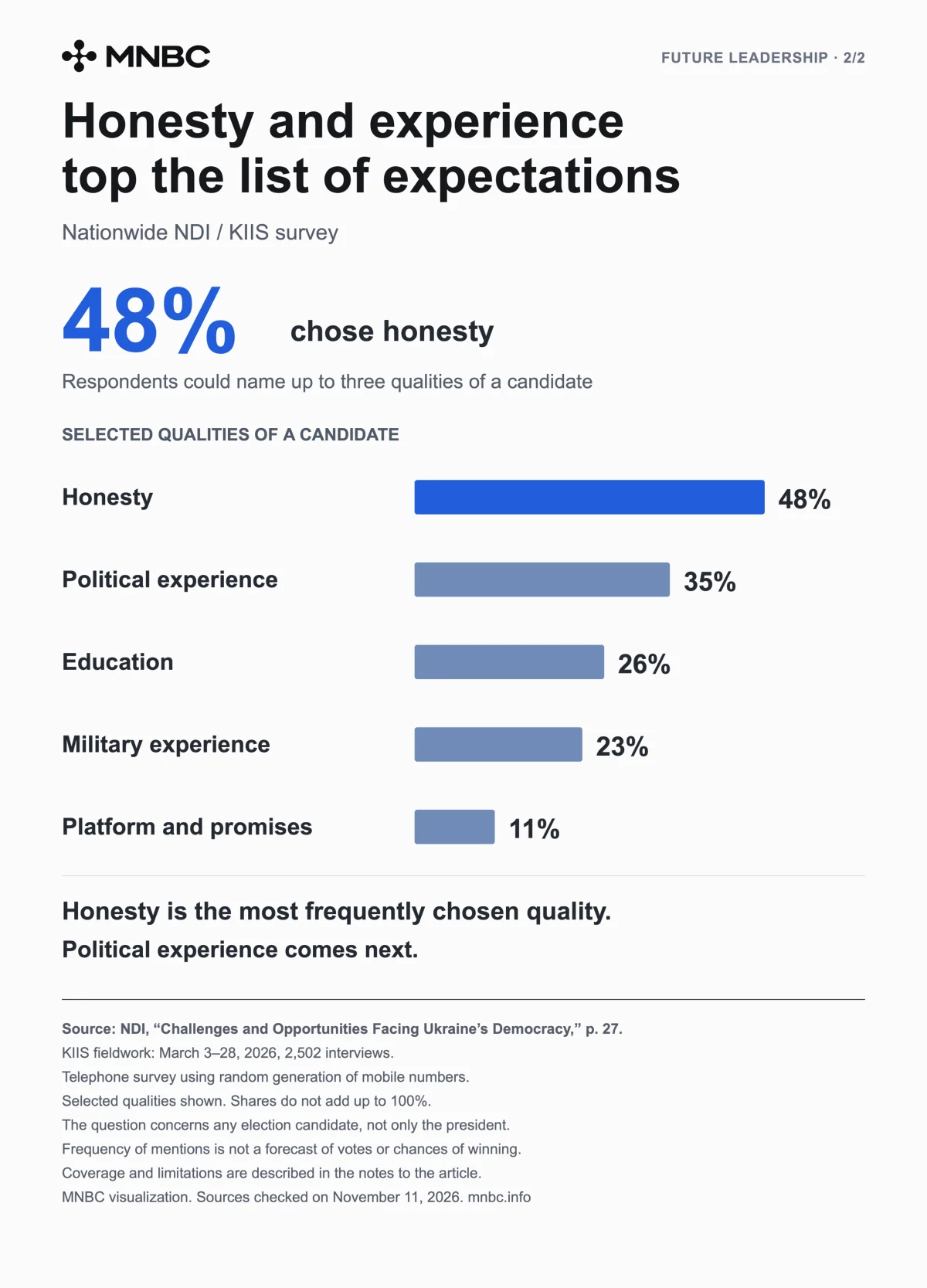
In March 2026, KIIS conducted a nationwide telephone survey for NDI. Respondents could name up to three qualities that matter when choosing a candidate in an election. Honesty was chosen by 48%, political experience by 35%, education by 26% and military experience by 23%.
This is where the tension between novelty and experience shows. In the Razumkov question, new faces are defined as people who have never held power. That does not necessarily make them novices with no political experience. They may have worked in parties or political movements without holding public office.
When asked what draws them to a party, respondents most often chose a combined option: the competence and honesty of its leadership. It was named by 42%. Openness and clear communication with people were cited by 27%, and a real track record by 24%.
A January KIIS survey is telling as well. At the time, 48% of respondents agreed that the current government includes genuine professionals and leaders who could stay in power after the war. Meanwhile, 42% saw it as thoroughly tainted and did not want any of its members in power after the war.
48% of respondents see professionals in the current government who could keep working after the war.
An anti-corruption program matters more than a strong leader
In the March NDI study, respondents were asked to imagine a new postwar party and name up to three features that would win their support. A real anti-corruption program was chosen by 33%, a strong and decisive leader by 16%. Decisions made by a team rather than by one person were mentioned by 13%.
Expectations of the person at the top sit alongside expectations of how the party works, from a concrete program to the way decisions are made.
A supplementary online survey by Active Group and Politarena in February 2026 found that 65% of participants supported a future president's willingness to compromise for the sake of results.
To back a new party, 33% of respondents named an anti-corruption program, and only 16% a strong and decisive leader.
War and corruption worry people at the same time
Expectations of politicians are easier to understand through the problems that concern people. In a September 2026 KIIS survey, respondents chose up to three issues that worried them most.
Top concerns, share of respondents
- Corruption in government: 50%
- Massive missile and drone attacks: 40%
- Unprofessional and incompetent government: 30%
- Low wages, pensions and other payments: 28%
Selected answers shown. KIIS, September 2026.
One detail of this study matters for understanding the war. Counting everyone who chose either the attacks or the situation at the front, the total is 53%. KIIS itself calculated this combined figure, accounting for overlapping answers. So the 50% for corruption does not mean the war has slipped into second place.
People expect the next government to protect the country and to govern with integrity. Integrity and professionalism take on practical meaning when it comes to wartime decisions and the use of shared resources.
Corruption was the single most cited problem. But 53% of respondents chose the attacks or the situation at the front.
Different generations and social groups set different priorities
There is no single picture of the desired government that fits everyone. In the NDI report, the researchers note that the oldest age group, 56 and over, more often chose the combined option of honest and competent leadership. Younger groups more often chose values, principles and a real track record.
Financial circumstances shift priorities too. Among those who said they could not even afford food, 32% named helping people in need as an important reason to support a new party. Across the whole sample, 19% chose this option.
Among those who cannot afford food, 32% named helping people in need, compared with 19% of the overall sample.
Trust will have to be earned through work
Given a direct choice, most people prefer new faces. At the same time, the share favoring experienced politicians is growing, and political experience remains an important quality in a candidate. Future leaders will have to answer both demands and show what lies behind the promise of renewal.
A new face opens the door. After that, trust has to be earned through reputation, experience and results.
How to read these data
This is an analysis of different surveys, not a single shared sample. The trend in demand for new leaders covers measurements up to November 2025; the other data come from 2026. The Active Group online panel is a supplementary source. Several questions allowed up to three answers, so shares do not add up to 100%. Expectations of a candidate, a party and a president are considered separately. The findings are not a voting forecast. Sources were checked as of November 11, 2026.
Sources
- Razumkov Centre, citizens' attitudes toward political forces and the need for new parties and politicians, November 2025 (in Ukrainian)
- NDI and KIIS, Challenges and Opportunities Facing Ukraine's Democracy, March 2026, pp. 3, 25–27 (in Ukrainian)
- KIIS, survey on the prospects of the current government after the war, January 2026 (in Ukrainian)
- KIIS, the problems that worry Ukrainians most, September 2026 (in Ukrainian)
- Active Group and Politarena, an electoral portrait of the ideal president, February 2026 (in Ukrainian)