A business of my own, someday: what is holding back Ukraine's would-be entrepreneurs
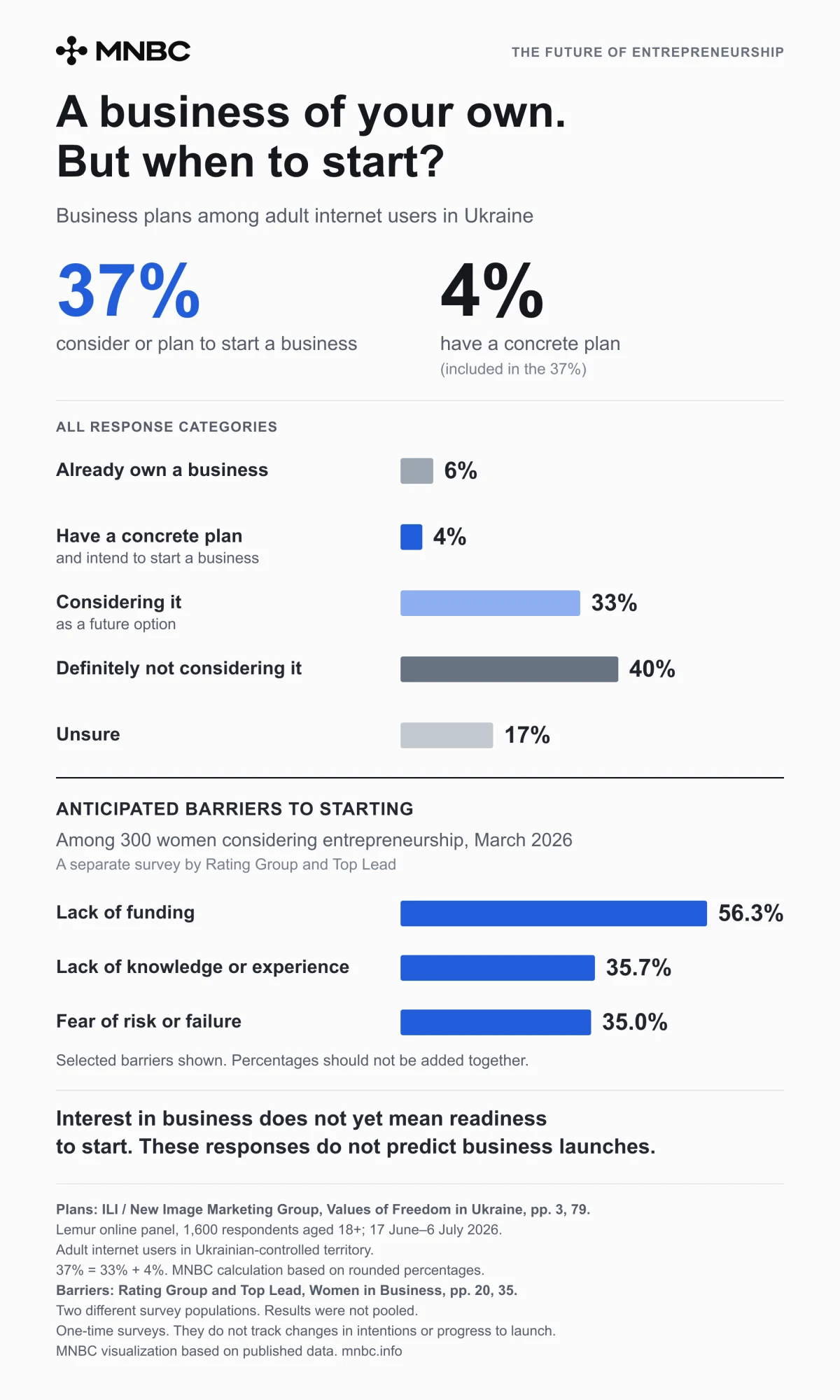
A third of adult internet users surveyed see a business of their own as an option for the future, yet only 4% have a concrete plan to launch one. Why the gap between interest and readiness is so wide, and what it means for the economy.


Ukrainians are still starting businesses. Yet for many people, a business of their own remains something for later. Getting from an idea to a launch means working out where the money will come from, whether there will be customers and how to get through the first few months.
The available surveys make this gap visible. But they give no grounds to claim that Ukrainians have stopped wanting to be entrepreneurs en masse. A far more useful question for government, banks and employers is what would help interested people actually launch.
Plenty of interest, far fewer concrete plans
In the Values of Freedom in Ukraine survey commissioned by the International Liberty Institute (ILI), 33% of respondents saw starting a business as one possible option for the future. Another 4% had a concrete plan and intended to start one. Some 6% already owned a business, 40% ruled the idea out entirely and 17% were unsure. The survey was conducted by New Image Marketing Group among 1,600 members of the Lemur online panel between June 17 and July 6, 2026. It covers adult internet users in Ukrainian-controlled territory.
In other words, 37% of respondents were either considering a business of their own or already had a concrete plan. This is our own calculation, combining two separate answer categories. But it would be premature to call all of these people future founders. Interest can stay just that for years.
The same gap shows up in a dedicated survey of women considering entrepreneurship by Rating Group and Top Lead. Of 300 women who were planning or considering a business, 44% were thinking about it as a long-term prospect and 32% had an idea but no timeline. Together that makes 76%. The two categories linked to actually preparing a launch added up to just 6%. The survey was conducted in March 2026. These figures describe women interested in entrepreneurship, not Ukrainian women as a whole.
A potential business often has no launch date. Support programs need to understand what stage a person is at and what is keeping them from taking the next step.
The business register shows no collapse in new ventures
According to data from the Unified State Register analyzed by Opendatabot, 222,288 sole proprietorships (FOPs) were registered in Ukraine in January–September 2026. In the same period of 2025 there were 225,046 registrations. By our calculation, that is a 1.2% decline. This modest dip does not, in itself, point to a mass retreat from entrepreneurship.
Over the first nine months of 2026, openings outnumbered closures by 66,643. But a registration does not show whether a person has started earning income or created any jobs. On top of that, some registrations are repeat ones: Opendatabot counted 30,033 such cases over the period.
Nor can a change in the desire to run a business be measured by comparing different surveys that ask different questions. None of the sources we used contains a comparable 2025–2026 series that would support the claim that "Ukrainians no longer want to start a business."
At the start, money and confidence are in short supply
The survey of women considering entrepreneurship offers a closer look at the barriers to entry. Lack of funding was cited most often. Lack of knowledge and experience and fear of failure were also among the leading obstacles.
Anticipated barriers to starting, share of 300 women considering entrepreneurship
- Lack of funding: 56.3%
- Lack of knowledge or experience: 35.7%
- Fear of risk or failure: 35.0%
Not an exhaustive list; percentages should not be added together.
A U-Report poll from May 9, 2025, sends a similar signal. Of the 3,877 participants who answered the relevant question, 2,723 named start-up capital as an obstacle for young people. By our calculation, that is 70.2%. U-Report is a voluntary platform, so the result describes its participants and is not an estimate for all young people in Ukraine.
For those designing support programs, this is an argument for checking whether access to funding comes with help getting off the ground. A would-be entrepreneur may need financing, a cost breakdown and proof that customers will pay for the product, all at once. The survey itself does not show that any particular program would solve these problems.
Money is a major barrier, but it does not answer every question a future entrepreneur faces. Support should also be judged by whether it helps test whether an idea is viable.
War and taxes shape expectations
A would-be entrepreneur has to estimate costs before earning any revenue. In wartime, the usual risk of getting the product wrong is compounded by threats to property, power supply and demand.
In the Rating Group and Top Lead survey, the women considering entrepreneurship most often named shrinking consumer purchasing power as a significant challenge to running a business, at 47.3%. A high tax burden was cited by 41.7%, power supply problems by 34.7% and damage to property from shelling by 21%. These are anticipated difficulties, not business losses these women have already suffered.
These answers show that future founders' attention is split across several risks. When it is unclear how many customers there will be and whether the premises will be able to operate, it is harder to tell whether there will be enough money for mandatory payments and the period before the business turns a profit.
At the same time, the survey does not allow us to count how many businesses were never launched specifically because of taxes or shelling. How often a problem is mentioned shows its place in people's expectations, but it does not measure its separate causal effect.
Running a business, freelancing and employment can overlap
A future entrepreneur is not always choosing between three mutually exclusive paths. A salaried job can be combined with a first few orders, and freelancing can be a way to test a service before a wider launch.
Among the women considering entrepreneurship in the Rating Group and Top Lead survey, 51.3% worked full-time for an employer. So the wish to run a business can coexist with a current job. But this figure does not tell us whether these women plan to quit once they launch.
For someone who cannot afford several months without income, testing an idea step by step may be the practical route. This is our own analytical conclusion, not a preference of the majority measured in surveys. The sources we used contain no reliable data on how many potential entrepreneurs in Ukraine choose freelancing over a business or a salaried job.
Becoming an entrepreneur can be a gradual process. Employers and support programs should keep in mind people who are still employed but already considering a business of their own.
What this means for the future of entrepreneurship
The available data do not support the picture of a mass loss of interest in starting a business. What they show is a sizable group of people for whom a business of their own remains an option with no set start date. Their intentions may still shift either way.
For government and international organizations, this points to the need to tell the stages of support apart. Someone without a tested idea needs different help from someone who is already looking for premises or preparing paperwork. A program's results should be tracked after launch, including whether the business gains customers and keeps operating.
For banks and investors, it is important to distinguish general interest from a readiness to commit money and start operating. The share of interested people is not a ready-made forecast of the number of borrowers or new companies. These surveys primarily describe the conditions for entering small business, not a pipeline of investment projects.
For employers, an employee's interest in starting a business does not mean they are about to quit. Some potential founders may combine work and preparation for a long time, or drop the idea after testing it.
Future entrepreneurial activity should be assessed by what happens between the idea and an operating business: how many people tested demand, found their first customer, started earning income and managed to keep going. Observations like these would help show whether Ukraine is losing potential entrepreneurs, and at what stage.
This piece is based on open sources checked as of November 9, 2026. MNBC carried out a secondary analysis of published results and simple arithmetic calculations. We did not conduct our own survey. Results from studies of different populations were not pooled into a single sample, and intentions were not treated as actual business launches.
Sources
- ILI / New Image Marketing Group, Values of Freedom in Ukraine, report, pp. 3, 78–79 (in Ukrainian)
- ILI, publication of the Values of Freedom in Ukraine findings (in Ukrainian)
- Rating Group, Women in Business 2026
- Rating Group and Top Lead, Women in Business 2026, report, pp. 23, 35, 40 (in Ukrainian)
- Top Lead, Women in Business, report page, p. 46
- Opendatabot, sole proprietorship registrations, January–September 2026
- Opendatabot, sole proprietorship registrations, January–September 2025
- Opendatabot, repeat sole proprietorship registrations in 2026
- U-Report, poll of May 9, 2025