Investing in wartime: plenty of interest, but not everyone has money to spare
Why the wish to invest does not always turn into actual investments, which assets investors already hold and how far ahead they are willing to plan.


An apartment to rent out, dollars set aside, bonds or crypto. Talk about investing often hides very different goals. Some people want to grow their capital, some are looking for extra income, and for others the priority is protecting their savings against unexpected expenses.
The available research shows a clear gap between interest in investing and actually holding investments. For many people, the first obstacle comes before they ever choose an asset: they simply have no spare money. After that come questions of trust, clear terms and the ability to get their money back.
MNBC compared published survey results with official data on government bonds. Because these sources describe different groups of people, we did not combine them into a single "ranking of the Ukrainian investor." Instead, we tried to pinpoint where the wish to start investing runs into reality.
Between "interested" and "already invested"
In a Kantar study presented in autumn 2025, 50% of respondents were interested in investing. 29% had some investment experience, but only 9% held investments at the time of the survey. The data cover an online audience aged 18–55 in cities with populations of 20,000 or more. The stated sample was 1,000 people.
Interest in investing does not automatically translate into demand for financial products. People who are only looking around need a clear first step. Someone with experience can already compare terms and instruments. Offering both groups the same product means ignoring the difference in what they need.
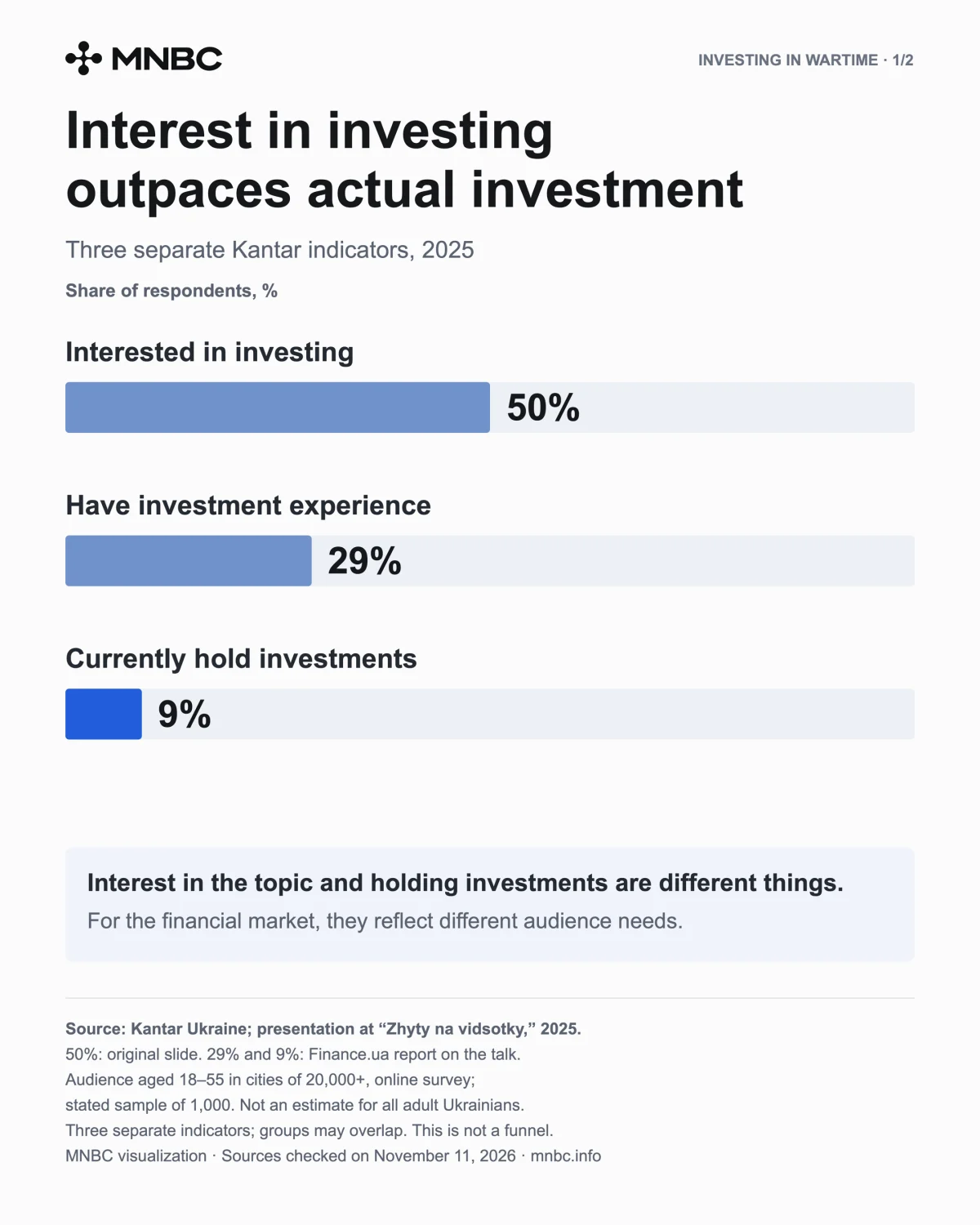
Someone who reads about investing does not necessarily have money they are ready to invest. For the financial market, these are two different audiences.
What is already in people's portfolios
Among Kantar respondents who held investments at the time of the survey, crypto and NFTs were mentioned most often. Next came a combined category of government and corporate bonds.
Assets among those holding investments, Kantar, 2024 → 2025
- Crypto and NFTs: 53% → 40%
- Government (OVDP) and corporate bonds: 17% → 34%
- Residential property in Ukraine: 22% → 20%
- Land in Ukraine: 13% → 13%
- Foreign stock markets: 7% → 11%
Selected categories from Kantar's original slide, which shows data for both 2024 and 2025. The shares do not describe the whole population or how money is split within portfolios. The slide does not state the exact size of this subgroup.
Portfolios changed noticeably in a year. The share of bonds among those holding investments doubled, from 17% to 34%. Crypto and NFTs kept first place, but their share fell from 53% to 40%.
There are also more recent figures on actual holdings. According to the Ministry of Finance, as of November 2, 2026, individuals held 173.1 billion hryvnias' worth of government bonds. That is a record high and 5.6 billion more than at the beginning of October. The figure refers to the size of the portfolio, not the number of holders.
Large sums invested and broad participation are not the same thing. The market can grow even while investing remains out of reach for many people.
Foreign currency and gold attract interest too
A separate perspective comes from a National Bank of Ukraine survey of service members, veterans and their families. In May–June 2025, 1,013 people took part voluntarily. Among the 824 participants who answered the question about which instruments interested them, 33.9% named buying foreign currency and 28.2% named precious metals, including gold and silver.
This reflects interest in instruments within a specific group, not a count of people in Ukraine who own foreign currency or gold. For this audience, familiar ways of storing money remain on the radar alongside other investment options.
What stops people before they invest at all
In the Kantar study, 44% of participants were not ready to invest. Within this group, the most common main reason was a lack of financial resources, cited by 49%. Another 18% did not know where to start, 16% pointed to a lack of trust and 12% were unable to choose.
Compared with 2024, lack of money has become a bigger obstacle: a year earlier, 41% of those not ready to invest named it. Lack of trust, by contrast, was mentioned less often, by 16% compared with 25% a year earlier. Kantar titled the slide with these figures "Financial resources are shrinking."
This is an important correction to the talk about a "fear of investing." Financial education can help people understand an instrument, but it cannot create spare money on its own. Nor will promises of high returns resolve the question of trust.
Among the barriers for people who are already ready to start, the researcher singled out the complexity of buying an asset and the inability to withdraw money from it. This is where liquidity comes in: the ability to turn an investment back into money you can use.
Does safety matter more than returns? The materials we reviewed contain no common question that would allow us to fairly judge which of these motives matters more. But it is clear that returns alone does not explain readiness to invest. Starting capital, trust and exit terms all matter.
Before offering people a chance to earn more, you need to explain how the investment works and on what terms they will get their money back.
Three years beats ten
Kantar offered participants three investment horizons. Three years was chosen by 71%, five years by 17% and ten years by 12%. This compares how appealing the proposed options were, not the actual terms of people's investments. A year earlier, the shares were 68%, 16% and 16%. The appeal of the longest horizon fell the most, from 16% to 12%.
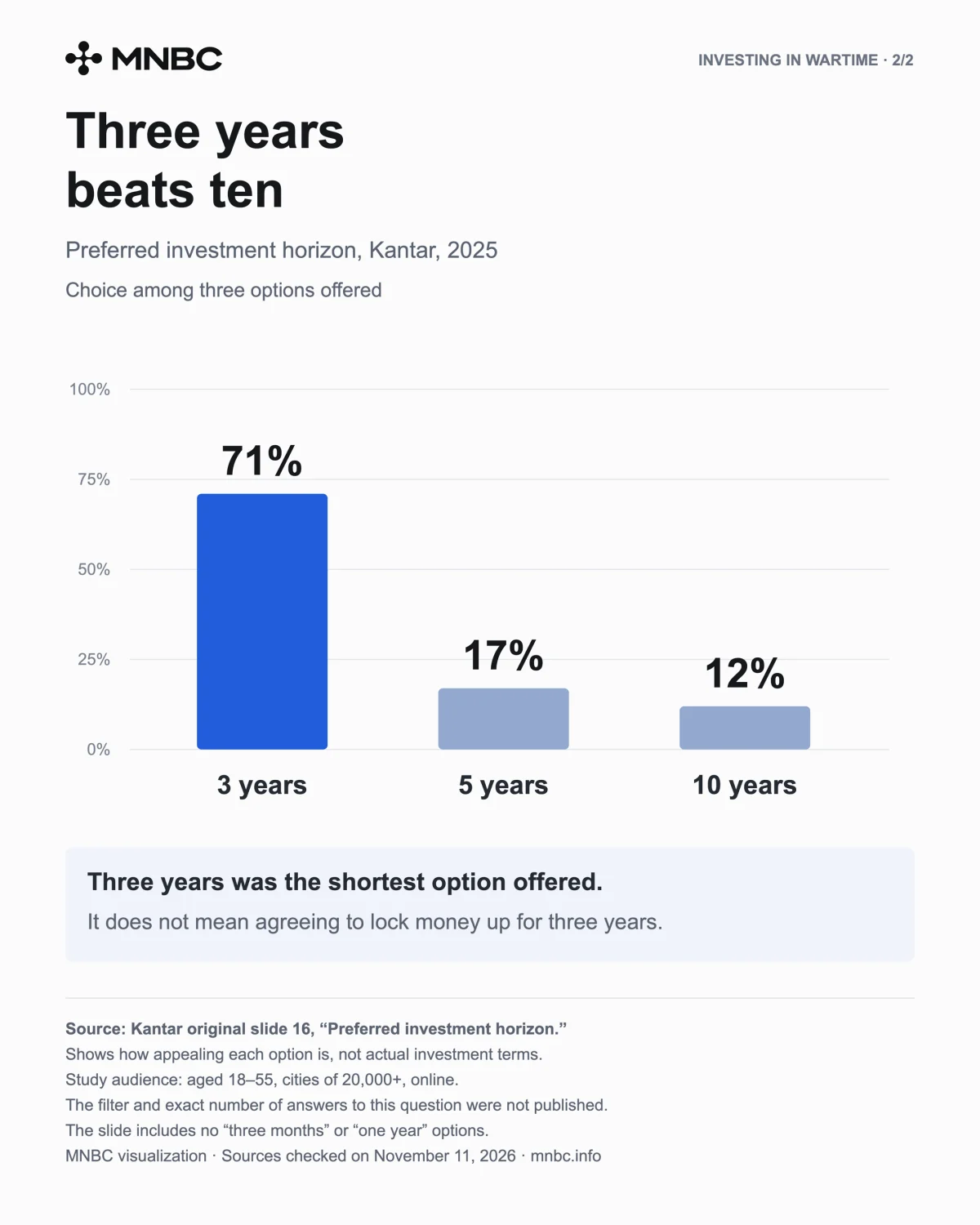
The shortest of the three options has a clear lead. For banks, investment firms and developers, this is a hint about communication. A five- or ten-year offer needs to explain why it is worth planning that far ahead and what options the investor will have along the way.
This brings us back to liquidity. Finding a three-year investment appealing does not mean agreeing to go without access to the money for that whole time. Early exit terms, where they exist, can matter as much to the decision as the maturity date.
Age changes the goal, but does not produce a ready-made portrait
In Kantar's presentation, respondents aged 41–55 named passive income as a goal more often than those aged 18–29: 33% versus 24%. For the younger group, the researcher highlighted financial independence as a separate motive.
The same product can serve different life goals. For some, it is a way to depend less on a salary or on family; for others, an extra source of income. This view is more useful than the familiar split into "young people in crypto" and "older people in property," for which there is not enough data here. The study does not cover people over 55.
Advertising returns alone will not create investors
The most striking takeaway from these data is the distance between interest and the ability to act. Some people lack money, and that obstacle has grown over the past year. Others lack a clear first step, trust or acceptable terms for getting their money back.
That defines the practical task for the financial market. It needs to explain not only potential earnings, but also the entry amount, costs, risks and how to exit. For a developer, a bank or an investment platform, these are different products, but for the individual the question is the same. Will they still be in control of their own money after they invest it?
How to read these data
This is an editorial analysis of published results, not MNBC's own survey. The main data on interest, experience and investment horizons come from Kantar's 2025 study of an online audience aged 18–55 in cities with 20,000 or more residents. The comparison with 2024 comes from the same Kantar slides. The NBU survey covers volunteers from the military and veteran community. Government bond figures are as of November 2, 2026. The materials used do not include a full open dataset of individual responses.
Sources
- Minfin (minfin.com.ua), Kantar presentation on Ukrainians' investment sentiment, November 2025 (in Ukrainian)
- Finance.ua, report on Kantar Ukraine's talk about Ukrainians' investments (in Ukrainian)
- Kantar, slide 10: interest in investing (in Ukrainian)
- Kantar, slide on investment types among current investors (in Ukrainian)
- Kantar, slide 14: reasons for not being ready to invest (in Ukrainian)
- Kantar, slide 16: preferred investment horizon (in Ukrainian)
- Kantar, slide 27: investment goals (in Ukrainian)
- Ministry of Finance of Ukraine, government bonds held by individuals, November 9, 2026 (in Ukrainian)
- National Bank of Ukraine, report on a financial literacy survey of service members, veterans and their families, pp. 5, 22–23 (in Ukrainian)