A society of fatigue: hope is there, but everyday footing is not
Six in ten KIIS respondents choose a scenario in which Ukraine is prosperous ten years from now. In another study, three in ten say they almost always lack the energy for everyday tasks. Faith in the future persists alongside exhaustion and financial insecurity. How does this fit with people’s plans for work, moving and family?


The gap is clearest when two indicators are tracked over time. Between the second quarter of 2025 and October 2026, the long-term hope component rose by 19 points on MNBC's 0–100 scale. Over the same period, the consumer component fell by about 4.8 points. These figures are our own recalculation of published KIIS and Info Sapiens data. MNBC calculations
Hope has bounced back from its 2025 low, but consumer confidence has not followed. That is the core story of this piece. Ukrainians are holding on to the future they want, while decisions about work, study or moving still have to be made within the constraints of today.
Hope is there, and so is exhaustion
In October 2026, 61% of respondents in a KIIS survey chose a scenario in which Ukraine, ten years from now, is a prosperous member of the EU. Some 27% picked the pessimistic scenario of a ruined economy and large-scale population outflow, and 12% were unsure.
Alongside this sits a different picture. In a July 2026 survey by the Institute of Sociology of the National Academy of Sciences of Ukraine, 30% of respondents said they almost always lacked the energy for everyday tasks. Another 37% felt this way from time to time.
Both findings matter for understanding the public mood. Long-term faith in the country keeps the desired future in view. Lack of energy describes what everyday life is costing people right now.
Faith in the country's future is no substitute for the energy it takes to get through an ordinary day.
Over the next six months, personal expectations run ahead of national ones
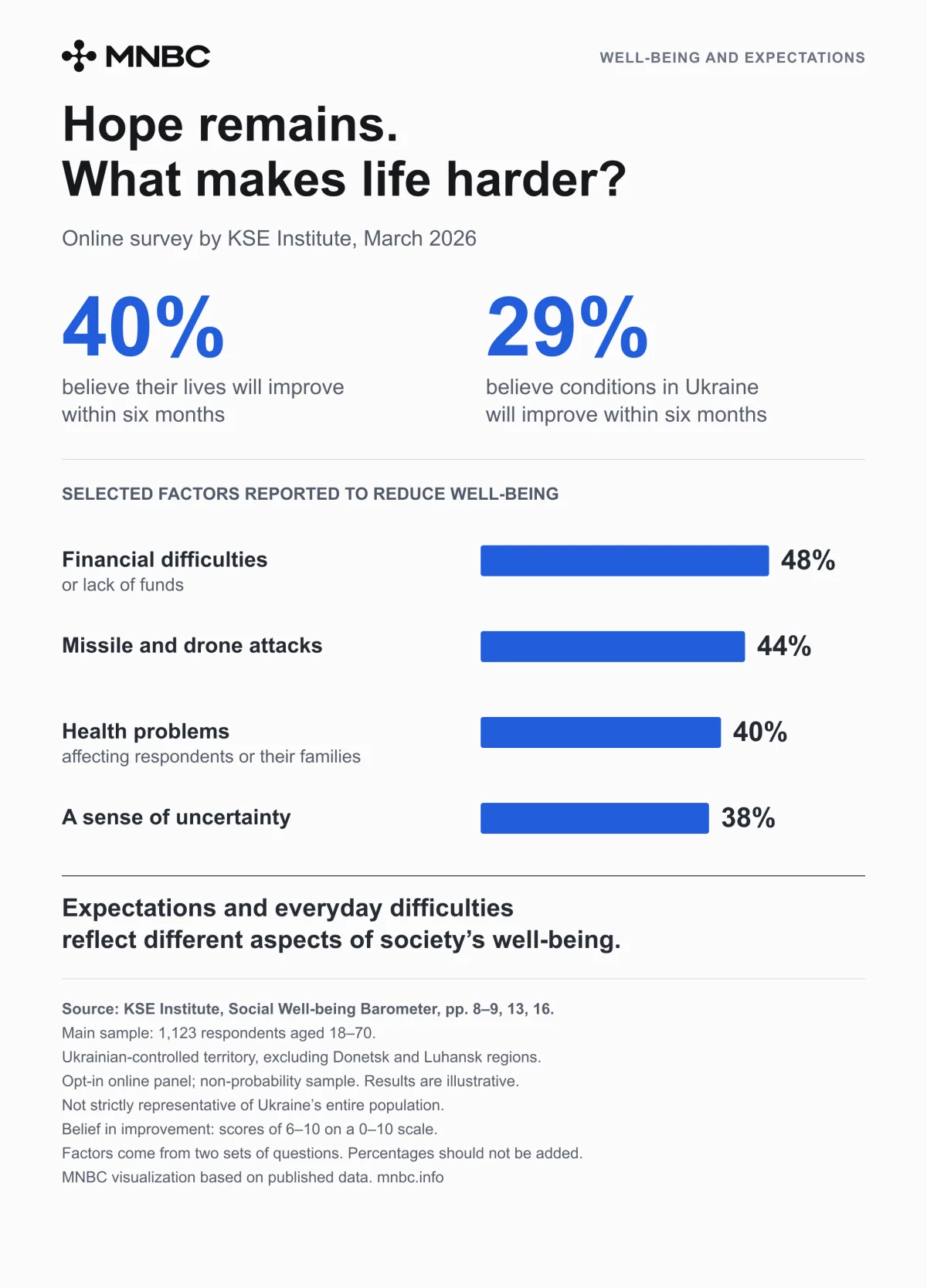
In March 2026, 40% of participants in the main sample of a KSE Institute study believed their lives would improve over the next six months. Only 29% expected the overall situation in Ukraine to improve. Personal expectations outpaced national ones by 11 percentage points.
The study was conducted on an opt-in online panel of 1,123 participants aged 18–70, and its authors describe the results as illustrative. In this sample, people's own near-term prospects looked brighter than the country's.
In KIIS's ten-year scenario, by contrast, most respondents choose a positive future for Ukraine. These are different studies with different audiences and time horizons. Taken together, they show why any conversation about the future needs a specific timeframe. Expectations for the next six months and hope for the next decade mean different things.
In the KSE sample, people's expectations for their own lives over the next six months were 11 percentage points higher than their expectations for the country.
Young people want independence and self-fulfillment
The future young Ukrainians want has a very concrete shape. In a study by UNDP, Ukraine's Ministry of Youth and Sports and Rating Sociological Group, 57% of respondents listed financial independence among their top three goals for the next five years. Self-fulfillment was chosen by 46%.
Goals for the next five years, share of young people surveyed in Ukraine
- Financial independence: 57%
- Self-fulfillment: 46%
- Starting a family: 24%
- A new profession or new skills: 12%
Selected answers shown. Survey of 2,050 people aged 14–35 conducted in September 2025; respondents could choose up to three goals.
Young people's ambitions cover earning their own income, developing their abilities and being free to choose what they do. Starting a family remains among their goals as well. Almost a quarter chose it, but that share reflects priorities for the next five years, not attitudes toward family in general.
Financial independence is among the top three goals for 57% of the young people surveyed, and self-fulfillment for 46%.
Higher pay could keep teachers in their jobs
Career plans show how much working conditions matter. In a separate KSE sample of 359 teachers at public schools, 21% planned to move into a field outside education within the next six months.
Among the 107 teachers in this sample who were planning any change of main job, 79% said a pay rise could change their decision. A lighter workload was mentioned by 30%.
This group leaves room for employers to keep their staff. Better pay and a manageable workload could sway decisions before people actually leave. Here, fatigue takes on a very concrete meaning: wages and the way work is organized.
For 79% of the teachers who were planning to change jobs, higher pay could be a reason to reconsider.
Among reasons to leave, prosperity outranks the war
In the 2025 youth survey, 29% of respondents wanted to emigrate from Ukraine, while 68% did not. Those who wanted to leave cited material well-being (47%), the fighting (39%) and better job opportunities abroad (35%). The question about reasons was answered by 595 people.
Both safety and economic prospects shape the wish to leave. Any discussion of young people's future in Ukraine therefore has to include the chance to earn a decent living and grow professionally. Almost a third say they want to emigrate, but a larger group has no such wish.
Two-thirds of the young people surveyed did not want to emigrate. Among those who did, material well-being came up more often than the war.
Long-term goals coexist with short-term planning
In a summer 2024 survey by the Institute of Sociology, 40.2% of respondents either did not plan their lives at all or planned no further than a day, a week or a month ahead. Meanwhile, 19% planned years ahead. These data were analyzed in a peer-reviewed article by Oleksii Viedrov published in 2026.
In youth focus groups held in 2025, participants also talked about planning only for the short term and rethinking their career ambitions.
A desired profession, a business of one's own or a family can remain guiding goals even when the next step is hard to pin to a date. Separating a life goal from the timeline for reaching it helps explain how long-term ambitions coexist with short-term planning.
You can know what you want and still not know when you'll be able to do it.
A sense of footing has to return to everyday life
In the KSE study, financial difficulties were named as a factor reducing well-being by 48% of participants in the main sample, and health problems affecting themselves or their families by 40%. In a separate set of questions about the war, 44% cited missile and drone attacks and 38% cited uncertainty.
Our conclusion from these data is a practical one. Employers should work on pay and workload so that people can plan their income and recover their energy. Communities and the state need to ensure access to healthcare, safe living conditions and employment. For international programs, a useful benchmark is whether the support people receive helps them return to study, work or setting up a home.
Hope is already a social resource. Support makes a tangible difference when it opens up the chance to take the next step in one's own life.
Everyday footing has a concrete meaning: predictable income, accessible help and the ability to make decisions about one's own life.
The MNBC Index average hides a widening gap
To see these differences side by side, we created the MNBC Experimental Index of Public and Consumer Sentiment. It combines, with equal weights, long-term hope for the country from KIIS, assessments of the country's current direction from Rating Group, and consumer sentiment from Info Sapiens. A result near 50 reflects higher expectations for the country's future combined with weaker consumer confidence.
The preliminary estimate for the fourth quarter of 2026 is 49.8 points out of 100, down from 52.6 in the third quarter. The preliminary calculation combines October data from KIIS and Info Sapiens with Rating Group's August value carried forward. It is the components that explain what lies behind the average. MNBC methodology, sources and open calculations
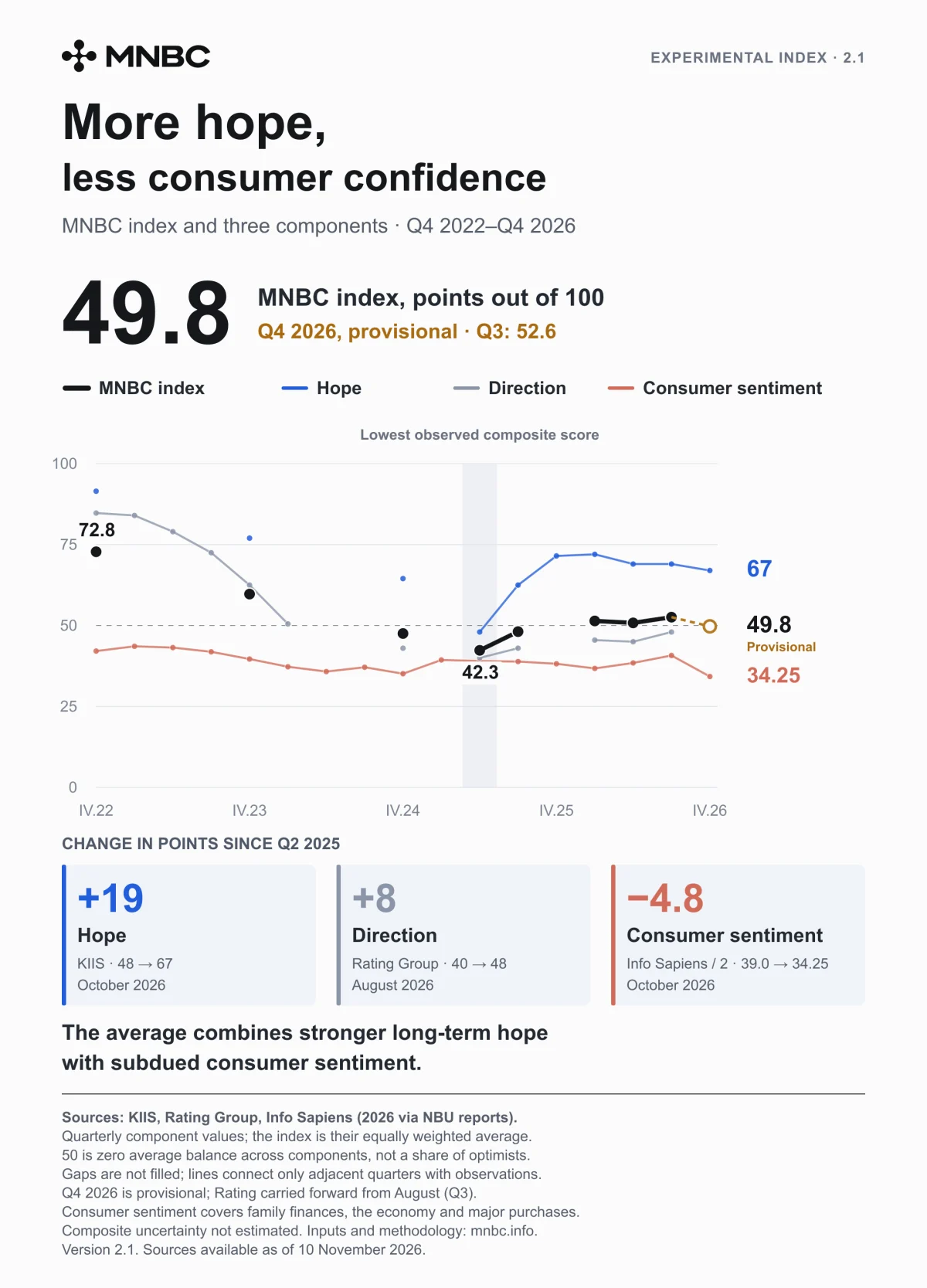
Since the second quarter of 2025, the hope component has risen by 19 points while the consumer component has fallen by about 4.8. The average conceals how far apart their paths have moved.
A society of fatigue still holds on to long-term hope. Its everyday question is what people can rely on right now. For employers, communities and the state, that is a shared practical task: helping people move from what they want to a step they can actually take in their work, studies or personal lives.
How to read these data
This piece combines different surveys, not the answers of the same people. The KSE data are illustrative, and the teacher sample describes a single occupational group. The youth study covers people aged 14–35 in 2025, and the planning data refer to summer 2024. Wishes and plans are not forecasts of actual moves, resignations or family decisions. The MNBC Index describes sentiment, not incomes or levels of fatigue, and the Q4 estimate is preliminary. Sources and calculations are as of November 10, 2026. Full methodology.
Sources
- KIIS, scenarios for Ukraine's future in ten years, October 2026 (in Ukrainian)
- Institute of Sociology, National Academy of Sciences of Ukraine, omnibus survey, wave 1, July 2026 (in Ukrainian)
- KSE Institute, Social Well-being Barometer, pp. 13, 16, 39 (in Ukrainian)
- UNDP, Ministry of Youth and Sports and Rating Group, the impact of the war on young people in Ukraine, report, pp. 6–7, 21, 32, 52–53 (in Ukrainian)
- Oleksii Viedrov, article in Sociology: Theory, Methods, Marketing, 2026, no. 1, pp. 99–100 (in Ukrainian)
- Rating Group, Ukrainians' socio-political views, August 2026, p. 45 (direction of the country over time) (in Ukrainian)
- Info Sapiens, consumer sentiment index (monthly releases through December 2025) (in Ukrainian)
- National Bank of Ukraine, Inflation Report, October 2026, p. 18 (Info Sapiens consumer sentiment index for 2026) (in Ukrainian)
- MNBC, index methodology and calculations