New Operational data analysis
AML in plain terms: how your crypto transfers are checked and your money is protected
How checking where funds come from helps protect users, when an additional request comes up, and what happens to the transfer. Research based on Trustee Plus data.
 Project leadMariia KovalchukData analyst

- Population
- Trustee Plus transactions
- Commissioned by
- MNBC initiative
- Published
- 13.11.2026
Key findings in 30 seconds
- 100%of transactions go through AML screening, according to the service.
- ≈0.04%of transactions need an enhanced review involving the user.
- ≈51%of reviews in the reported distribution take 1–2 days.
- ≈96.5%of reviews in the same distribution take between 1 and 7 days.
When you receive crypto, it matters where the funds came from. Behind an ordinary incoming transfer there may be earlier transactions the recipient knows nothing about, including links to fraud, stolen assets or sanctioned addresses.
An AML check helps catch these risks. The service assesses the transfer and, if needed, clarifies where the funds came from before deciding whether to credit them. For the user, this is an extra layer of protection against accepting assets with a risky history. How Trustee Plus describes it.
We analyzed Trustee Plus operational data to explain how this protection works, when the user needs to get involved and what happens after an additional request.
What AML is and why services check where funds come from
AML stands for anti-money laundering. Money laundering means hiding the criminal origin of money: for example, running the proceeds of fraud through a series of transactions so they are easier to use later. AML takes its name from countering exactly this kind of concealment. FATF explanation.
In crypto, analysts look at addresses, the links between transfers and the likely origin of assets. “Dirty crypto” usually refers to funds with risky links somewhere in their transaction history. These links, along with unusual transaction patterns, are among the signals AML analysis pays attention to. FATF risk indicators.
Imagine someone honestly sells a product and gets paid from an address linked to stolen assets. The recipient may have had no idea. The check gives the service a chance to spot that link and look into the circumstances before the funds are credited. That is its practical value for the user.
Checking where funds come from helps spot a risk the recipient may not even suspect.
When the AML check happens and what the service does
When a crypto service receives an incoming transfer, it checks where the funds came from. In simplified form, the process looks like this:
- The service receives the transfer details. The analysis uses data on the transaction and the addresses linked to it.
- It assesses possible risks. It checks for links to known illicit activity and other signs that need attention.
- If needed, it asks for an explanation. If the circumstances need clarifying, crediting may be put on hold and the user asked to provide information about where the funds came from.
- It makes a decision after the review. At Trustee Plus, the funds can be credited or returned to the sender, provided no legal restrictions apply. The decision depends on the specific case.
This check happens when the service accepts the funds and decides whether to credit them to the balance. The incoming transaction itself may already be confirmed on the blockchain. How incoming deposits are screened.
Every transaction is screened. Extra questions are rare
According to Trustee Plus operational data, every transaction goes through AML screening. About 99.96% do not need an enhanced review involving the user, while about 0.04% do. In other words, being screened does not mean you will be asked to explain anything.
To make the proportion easier to picture, take a notional 100,000 transactions. Roughly 99,960 of them clear without an enhanced review involving the user, and 40 go to one. This is a way to illustrate the share, not the actual sample size.
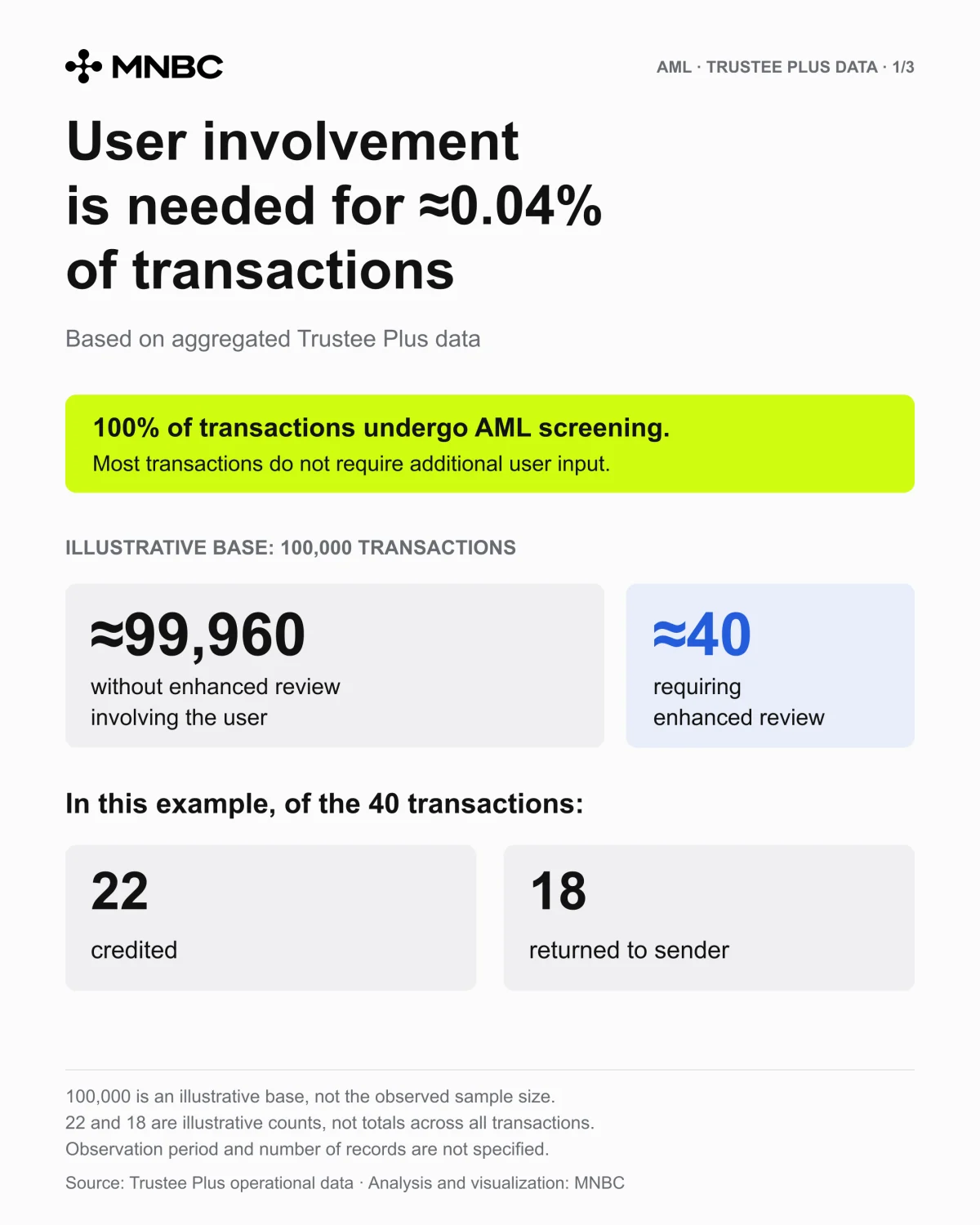
In the same example, 22 of the 40 transactions are credited after the review and 18 are returned to the sender. This is an illustration, not a set of absolute totals for all Trustee Plus transactions.
The provider describes crediting and returning funds as the possible outcomes of a review, provided no legal restrictions apply. The decision depends on the circumstances of each transaction. An enhanced review does not, in itself, mean the funds are lost.
To judge the user experience, two things matter: how often enhanced reviews happen, and how clearly users can see what happens after a request.
What can trigger an enhanced review
A review can be triggered by direct contact with a high-risk address or by a link through earlier transactions. The research groups the signals into eight categories.
- Direct interaction with a high-risk address: the transaction is linked to such an address directly.
- Indirect exposure: a link through a chain of several transactions.
- Mixers or darknet: links to such services or addresses.
- Sanctions or fraud: identified links to sanctioned addresses or fraudulent activity.
- Stolen funds: a possible link between the origin of the assets and theft.
- Unusual behavior: atypical transaction characteristics.
- High-risk jurisdictions: links between the transaction and such jurisdictions.
- Other AML risk indicators: additional grounds for assessment.
This is a list of possible grounds for a review. The publication does not give how often each one occurs or what thresholds trigger it. A signal on its own does not mean the user has broken the law.
How long a review takes
In the reported distribution, the largest share of reviews, about 51%, takes 1–2 days. Another 45.5% or so take 3–7 days. About 3% take 8–30 days, and about 0.5% take more than a month. Together, the first two categories account for roughly 96.5%.
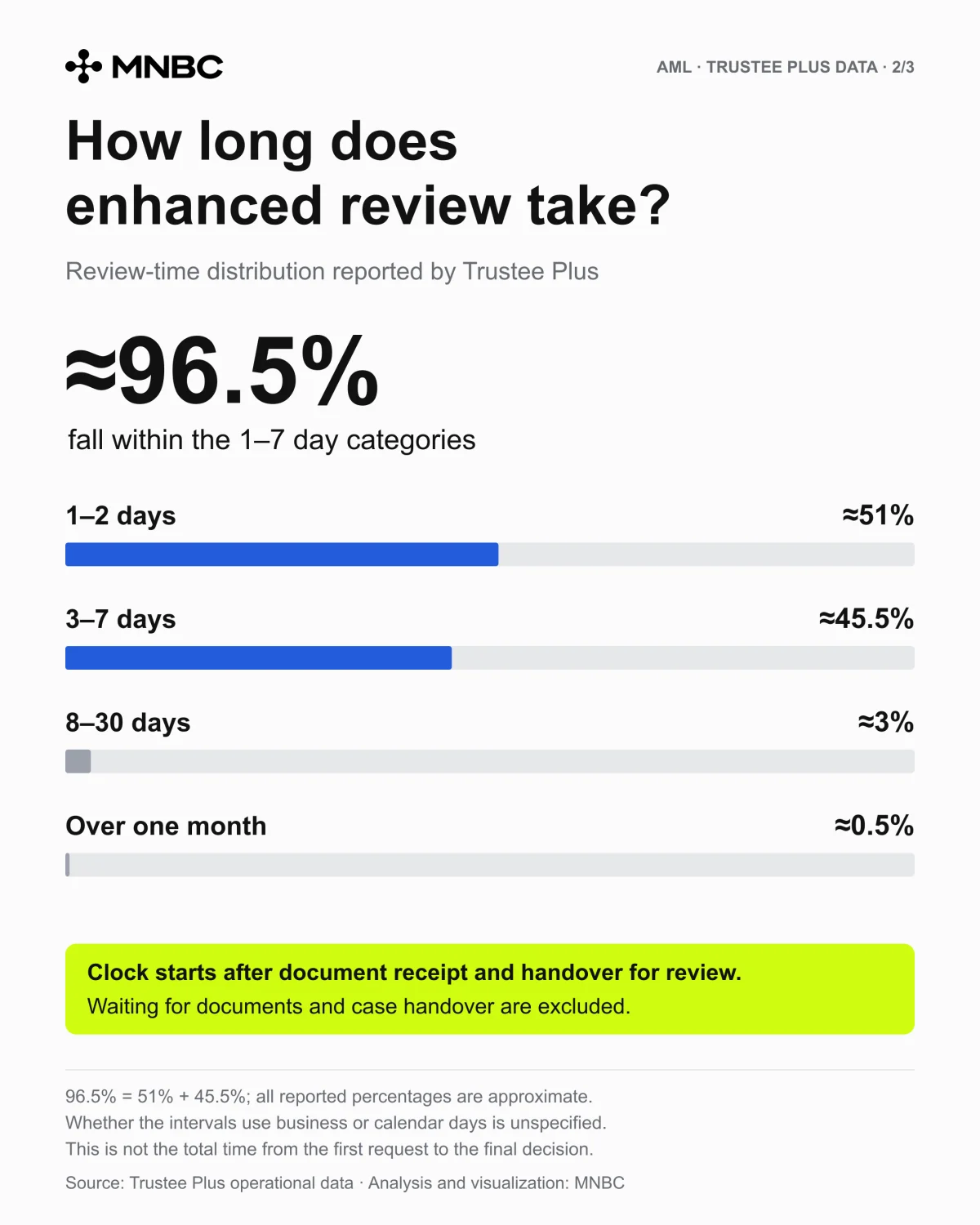
When the clock starts matters a great deal here. According to Trustee Plus, time is counted from the moment the information and documents are received and the case is passed on for review. Waiting for documents and the handover itself are not included. So these figures do not cover the full time from when a transaction is first held to the final decision.
A protective check sometimes takes time. For users, this means it is worth asking which stage the case is at. A document request, receipt of the documents and the start of the review can all happen at different times. A clear status helps match expectations to the published figures.
What public complaints show
We also looked at a snapshot of public mentions, using enhanced AML reviews involving users as the base.
- Left a review: 3%.
- Posted on social media: 2%.
- No public mention found: 95%.
Taken together, reviews and social media posts give a benchmark of about 5%, which the research uses to gauge how visible the AML topic is. The publication does not detail how mentions were searched for or matched to cases.
This snapshot describes how visible cases are in public. The absence of a mention does not tell us whether the person was satisfied with the outcome, and the presence of a complaint does not show it was justified. These shares cannot be used to measure how well AML cases are resolved overall.
How answers differ before and after AML is explained
A separate part of the research covers survey results. Participants were asked: “What do you think happens to the funds if a transaction is sent for enhanced review?” Answers are shown before and after the process was explained.
- Temporarily frozen: ≈23% before the explanation, ≈64% after, a change of ≈+41 pp.
- May be lost: ≈34% before, ≈6% after, a change of ≈−28 pp.
- Returned: ≈16% before, ≈28% after, a change of ≈+12 pp.
- Kept by the service: ≈27% before, ≈2% after, a change of ≈−25 pp.
Percentage-point changes calculated by MNBC from rounded response shares.
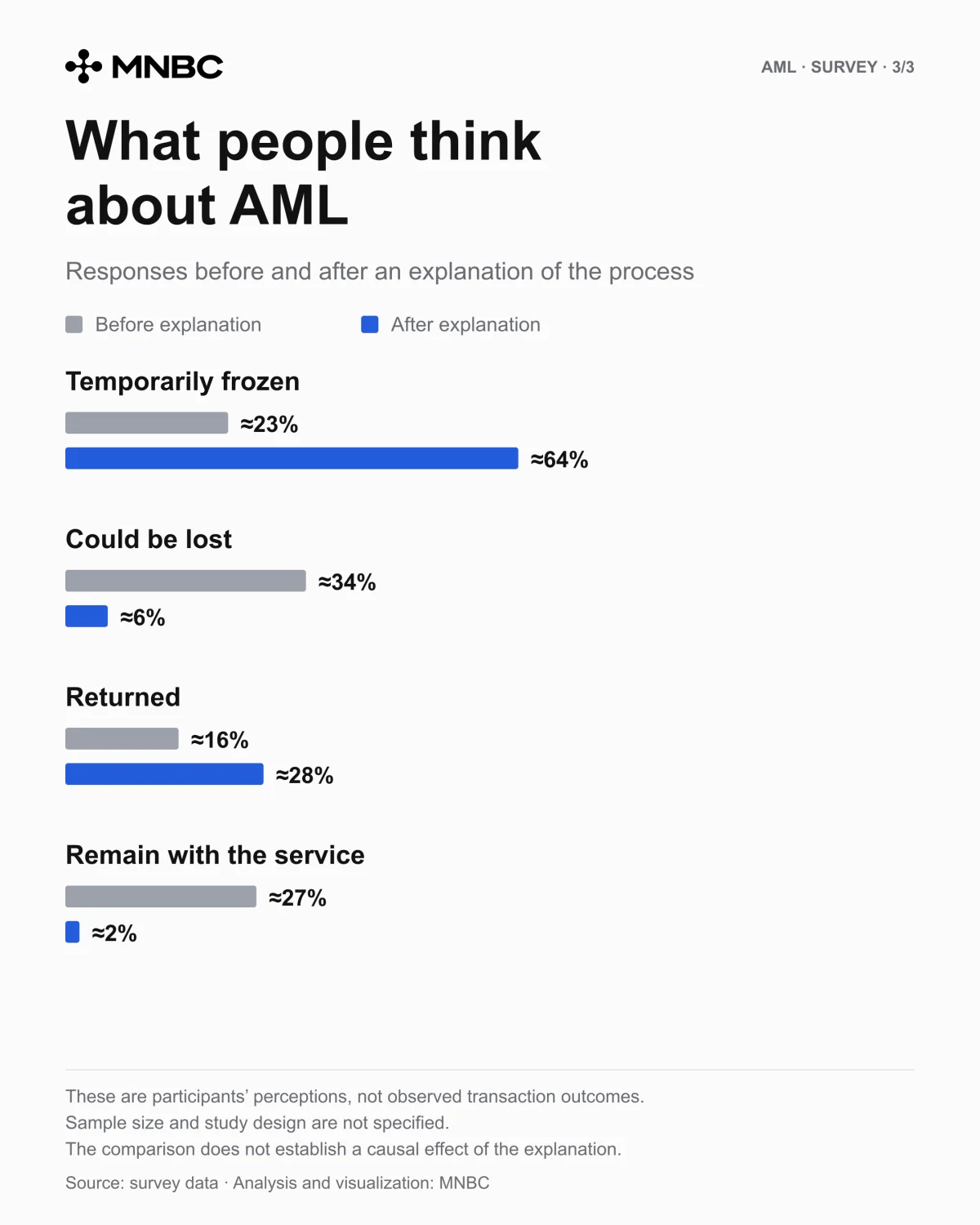
In this comparison, participants were more likely to choose “temporarily frozen” or “returned” after the explanation. The share saying the funds may be lost fell by about 28 percentage points. These figures describe what participants believe, not how often funds are actually lost or returned.
The publication does not disclose the sample size, how participants were recruited, what the explanation said, or whether the same people answered before and after. So this is an observation about answers in the comparison provided. It does not measure the causal effect of the explanation and cannot be extended to all users.
Transaction data shows what happens to transactions. The survey shows how participants understand it. The two sets of results should be read separately.
What to do if a service asks for more information
Trustee Plus advises contacting official support in the app or on the website. A request for an enhanced review means the transaction needs a closer look. Find out what information the service needs and provide it promptly. This helps the case move to review sooner.
A separate piece of advice concerns third-party “helpers”. Do not share personal data with them or pay anyone who promises to sort out an AML review. Any communication about a specific transaction should go through official channels.
Once the review is complete, the provider recommends confirming the decision on the funds. For future deposits, copy the current address directly from the app and pay attention to where assets come from, avoiding high-risk platforms and addresses with a questionable reputation.
Conclusions
An AML check helps assess which funds are coming into the balance and flag a risky history in time. Trustee Plus data shows that this protection mostly works without involving the user. Every transaction is screened; extra requests affect about 0.04%. In the reported distribution, most reviews take 1–2 days, and about 96.5% take 1–7 days from the defined starting point.
For the recipient, the practical value of AML is a lower risk of accepting funds of problematic origin. When an enhanced review is needed, this protection should come with a clear explanation of the reason, the information required, the current stage and the possible outcomes.
Trustee Plus describes its own role as screening transactions and, where necessary, refusing to credit funds of high-risk origin. This is the provider’s position on risk management. The figures help assess certain aspects of the process, but they are not an audit of all its decisions or a guarantee of how any future review will turn out.
Sources
Operational figures come from Trustee Plus. Analysis, interpretation and visualization by MNBC. Survey responses are treated separately from transaction results.
To explain the terms and the general screening process, we used the FATF FAQ, the FATF red flag indicators for virtual assets and the official Trustee explanations linked in the text. These materials support the explanatory part; the research figures themselves come from the service’s data.
Methodology
MNBC conducted this research using Trustee Plus operational data. The material keeps four things apart: aggregate transaction figures, a notional example of 100,000 transactions, a snapshot of public mentions, and survey results before and after AML was explained.
The data period, total number of transactions, number of AML cases and survey parameters are not disclosed in this version. Review times are counted from receipt of information and documents and handover of the case for review; whether these are business or calendar days is not specified. Approximate values are marked as such.
Operational figures were provided by Trustee Plus; analysis and interpretation are by MNBC. This is not an independent audit of the service. The findings apply to Trustee Plus transactions and survey participants and do not extend to the crypto market as a whole. Prepared on November 13, 2026; this date does not replace the undisclosed period of the operational data.