Anchored on both sides: which Ukrainians plan to return, and which are putting down roots abroad
Jobs, housing, children's schools and loved ones create anchors on both sides of the border. What a family can count on in Ukraine shapes what its plans to return mean in practice.


In August 2026, Rating Group surveyed 1,000 Ukrainian refugees in Poland. Of those, 51% intend to return to Ukraine. Yet only 8% are ready to do so in the near future, while 43% are putting it off until the war ends. Another 26% do not plan to return, and 23% are undecided. Rating Group survey.
These answers reveal a gap between wanting to return and actually planning to. While the move is on hold, life goes on. People find work, children go to school, and families choose where to live and sort out their paperwork.
Let's call these supports anchors. It is our own way of describing people's different circumstances. Research offers no universal formula for counting such anchors and predicting who will definitely return. What it does offer is a clearer view of which barriers Ukraine can lower and which ties are worth nurturing now.
An intention to return does not come with a date
In the fifth wave of the survey by the Centre for Economic Strategy (CES) and Info Sapiens, conducted in December 2025 and January 2026, 43% of respondents said they definitely or probably planned to return. The opposite answer came from 36%. The share willing to return was unchanged from the previous wave. This is a snapshot of attitudes across several countries and does not cover Russia or Belarus. CES, pp. 9–10, 42.
A working paper published by the EBRD in March 2026 makes it possible to see how intentions translate into action. The researchers ran ten survey waves between June 2022 and May 2025, following the same people over time. Among those who in 2022 planned to return soon, 42% had gone back by the end of the observation period. Among those who intended to settle abroad, the figure was 1%. These are results within a research panel, not shares of all Ukrainian refugees. Adema, Aksoy, Giesing, Poutvaara, Refugee Return, pp. 1–4.
Initial plans say a lot. Even so, fewer than half of those set on a quick return actually went back during this period. So an employer hiring for next year, or a community planning school places, needs more than the overall share of people who want to come back. They need to know when and on what terms.
To plan for return, it matters when a family is ready to move and what it needs to do so. A general wish to return does not tell you how many future workers or pupils to expect.
A job provides an anchor, but not always a career
Employment abroad can bring stability and a sense of professional loss at the same time. A UNHCR analysis published in January 2026, based on more than 6,000 observations, found that about 60% of employed Ukrainian refugees in the European countries studied work below their skill level. UNHCR study.
This is an important signal for Ukrainian employers. Someone who can no longer work in their profession may welcome an offer to get back to it. But a mismatch between job and qualifications does not in itself show a readiness to move. Expectations about pay, safety and conditions for the family need to be explored separately.
A 2025 Norwegian study by NIBR at OsloMet shows both sides of the picture. Better language skills, improved finances and local social ties are linked to a wish to stay. At the same time, respondents who have not found suitable work or a social circle cite this among the main reasons to consider going back. OsloMet on the study's findings.
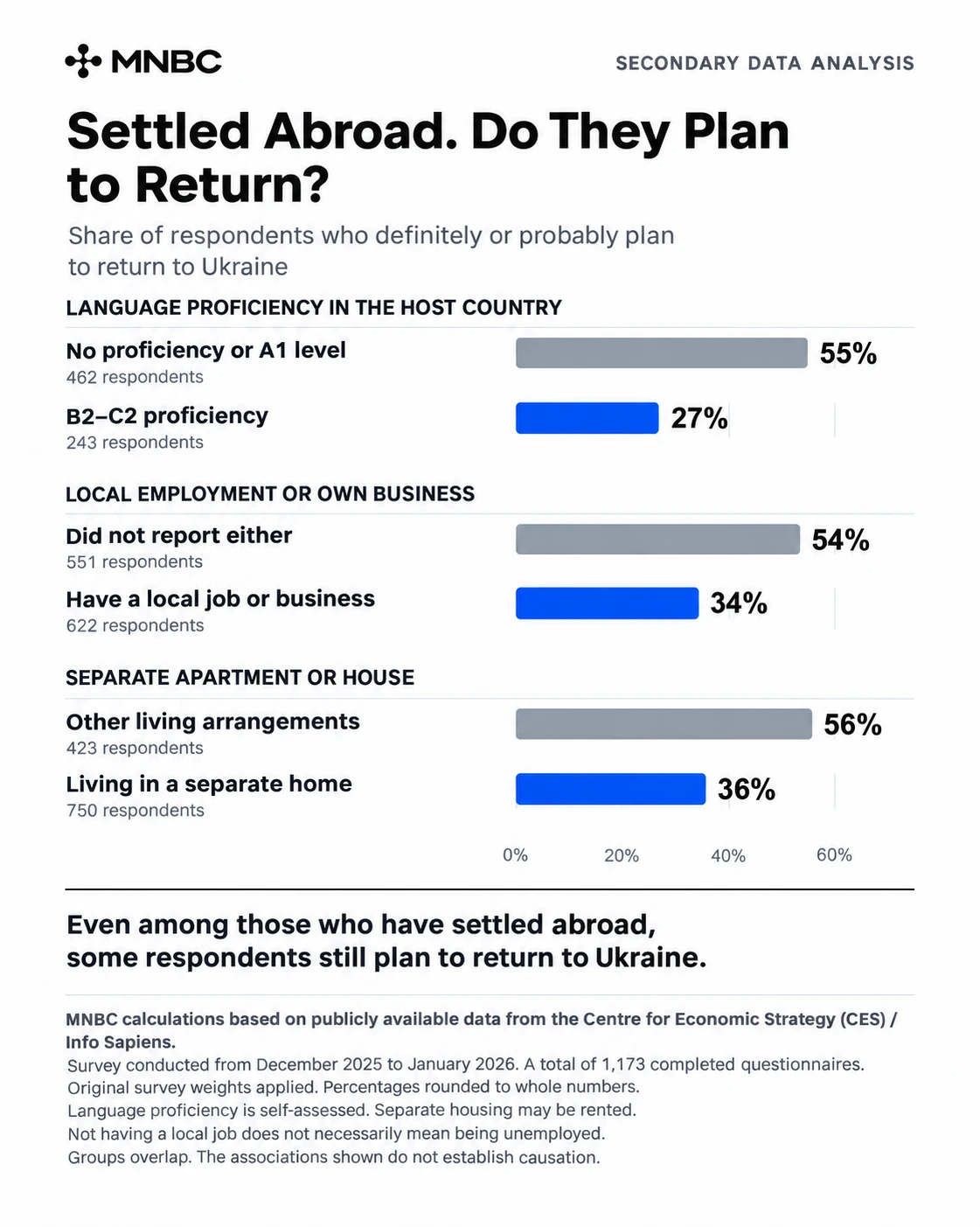
MNBC's own analysis of open CES / Info Sapiens data helps bring these differences into focus. Even among respondents with a local job or business, 34% plan to return, as do 27% of those who rate their language skills at B2–C2. Settling in abroad can go hand in hand with plans to go back.
Certainty about documents matters too. Temporary protection in the EU has been extended until March 4, 2028. Meanwhile, UNHCR recommends preparing accessible pathways to other forms of legal stay, especially for vulnerable people. Council of the EU Decision 2026/1912, UNHCR report, May 2026.
Securing a different status gives a family more certainty. But a work permit, a residence permit and a decision to stay for good are three different things. Documents alone cannot tell you what a person has ultimately chosen.
Children change the time horizon
In the CES survey, 47% of parents believe their children will not return to Ukraine. Another 32% expect them to come back, and the rest are undecided. These are parents' answers about their children's future, not a survey of the children themselves. CES, p. 45.
The same survey found that parents whose children study only remotely at Ukrainian schools are more likely to expect them to return. That does not mean the Ukrainian school is what drives the choice. Families intending to return may have chosen that form of schooling from the start. CES, p. 46.
For a family, moving also means a new class, a new language of instruction and new surroundings for the child. In the Norwegian study, parents voice concern about the impact of yet another move and about their children's future in Ukraine. OsloMet / NIBR.
The practical takeaway applies to the whole transition between school systems. Families need to be able to choose a school in advance, understand how prior learning will be recognized, and find out what support their child can get. For older children, university admission and recognition of their qualifications come into play as well.
A family return program should answer questions about a child's education as concretely as it answers questions about adults' jobs.
Returning to Ukraine and returning home may be two different things
In Rating Group's Polish survey, 71% of respondents named safety and stability as a condition that would encourage them to return. Economic growth matters to 36%, and job prospects to 26%. Respondents could name more than one condition. Rating Group.
In the CES survey, respondents also cited blackouts and the mobilization of men among the barriers to return. These are separate concerns for families weighing everyday risks and the chance to live together. The stated importance of these factors, however, does not show how many people would return if a given condition changed. CES, p. 49.
Yet even once the decision to return is made, the question of where remains. According to an IOM estimate based on a survey conducted in April–June 2026, about 1.5 million people had returned from abroad since the start of the full-scale invasion. Around 398,000 of them were still internally displaced within Ukraine. These estimates count people, not border crossings. IOM, Returning Home from Abroad, August 2026.
For these families, returning may mean starting over in a different community. That calls for affordable rentals, income and local services. A program built solely around restoring a family's former home will not cover all their needs.
Rokada and Socioinform examined this practical side in nine communities in the Lviv, Vinnytsia and Dnipropetrovsk regions. Participants talked about housing, adequate income, access to services and support after the move. The study involved 54 interviews and 18 focus groups. It sheds light on people's experiences but does not produce nationwide percentages. Study findings, August 2026.
Family ties can pull in both directions. In Norway, those whose loved ones stayed in Ukraine are more likely to plan a return. At the same time, a third of respondents hope to bring other family members to Norway. OsloMet / NIBR.
Support for return should also reach families who will be settling in a new community. For them, the road home starts with finding housing and a livelihood.
Four profiles instead of one "average refugee"
CES identified four groups with different circumstances. They help explain why the same support package will mean different things to different people.
- "Classic war refugees," 38.8%. Less settled abroad and more strongly oriented toward return.
- "Strongly connected," 21.6%. Active ties to Ukraine combined with settling in abroad.
- "Economically vulnerable," 17.4%. Greater difficulties with work, housing and finances.
- "New life path," 22.2%. Better settled abroad, with weaker intentions to return.
Source: CES, pp. 60–70. Descriptions abridged by the editors. These are profiles at the time of the survey. The intention to return was one of the characteristics used to form the groups, so this breakdown is not an independent model for predicting returns.
The group labels do not decide anyone's fate. What's more, the set of respondents changed from one survey wave to the next, so these data cannot track specific families moving between profiles.
The line between a temporary stay and a permanent move keeps shifting. One person may settle in abroad and still plan to return. Another may hold temporary status yet see no future for themselves in Ukraine. Practical work requires information on both intentions and life circumstances.
Business ties can survive the distance
In the "strongly connected" group, 19% of respondents earn a salary or business income from Ukraine. This figure applies to that specific profile, not to all refugees. CES, pp. 65–66.
For companies, this is a reason to consider a wider range of ways to work together. Remote employment, professional networks and business partnerships make it possible to maintain economic ties even before a potential move. How appealing these formats are to a given audience needs to be tested separately.
Real estate calls for the same caution. Renting abroad does not in itself prove that a stay is temporary. People may lack the funds or access to credit to buy. Owning a home in Ukraine does not show a readiness to return right now either.
The studies cited here do not provide a reliable estimate of how many Ukrainians abroad are willing to invest in Ukrainian businesses or real estate. For an investor, the next step should be to test specific demand, budgets and acceptable risk. Remittances to relatives, business experience and an intention to invest each need to be measured separately.
What this means for decision-makers
Government and communities need offers tailored to families' different circumstances. For those who have lost their homes, housing solutions in a community where they can actually live are key. Families with children need a clear path through the school transition. For people on low incomes, add early-stage support, help finding work and access to services. This approach is in line with OECD recommendations on preparing for return and reintegration. OECD, assessment and recommendations.
Predictability matters in dealings with the state, too. In the Norwegian study, return is linked to expectations of a safe, fair country with clear rules. That is why the quality of public services and trust in institutions should also be part of the conversation about return. OsloMet / NIBR.
Employers should offer a concrete path to a job. Candidates need to understand the duties, pay, safety conditions and any relocation support in advance. For professionals who lost their career footing abroad, return-to-profession programs make sense. Their effectiveness should be measured by actual hires and how long people stay in the job.
Investors should research specific needs. Affordable rentals, education services or support for entrepreneurs could be areas worth testing. Social need, however, is not the same as demand backed by the ability to pay. A financial model should account for household incomes, security risks and possible participation by the government or donors.
International organizations and host countries should support informed choice. Clear rules on legal stay, counseling and support for vulnerable people should go hand in hand with help for those who decide to return. UNHCR emphasizes that return should be voluntary, safe and sustainable. UNHCR report.
Return programs should be judged by life after the move. Six months and a year on, does the family have housing and income, are the children in school, and are the services they need within reach?
The main lesson of this research for Ukraine is a practical one. The chances of return should be tied to a family's ability to build a predictable life here. And professional, educational and business ties with those who remain abroad can be developed right now.
About the data
This piece mainly concerns people who left because of the full-scale war. The sources differ in geography, samples and question wording, so their percentages do not add up to a single forecast. The highlighted passages and practical recommendations are editorial conclusions. Sources were checked as of November 8, 2026. MNBC's own calculations were carried out on November 9, 2026.